GEOTECHNICALENGINEERING1
FRESNO
HomeUnderground ExcavationsGeotechnical design of deep excavations

Geotechnical Design of Deep Excavations in Fresno’s Central Valley

Sound ground. Sound decisions.

LEARN MORE

Fresno’s location in the heart of the San Joaquin Valley means that deep excavation projects encounter thick sequences of Holocene alluvium, interbedded silts, and clays with lenses of poorly graded sand. The semi-arid climate produces a deep groundwater table in the eastern part of the city, but it rises significantly toward the western reaches near the San Joaquin River floodplain, creating a marked contrast in dewatering demands across relatively short distances. We integrate regional stratigraphic models developed from hundreds of nearby borings to define lateral earth pressure envelopes that reflect the actual drained versus undrained behavior of these deposits. When the excavation exceeds 15 feet, the IBC and ASCE 7 require explicit consideration of seismic earth pressures, which in Fresno must include both the near-source effects of the San Andreas Fault and the basin amplification documented by the California Geological Survey.

In Fresno’s interbedded alluvium, the difference between a successful deep excavation and a costly delay often comes down to how well the dewatering system anticipates the perched water tables that rarely appear on pre-construction boring logs.
Our service areas

Process and scope

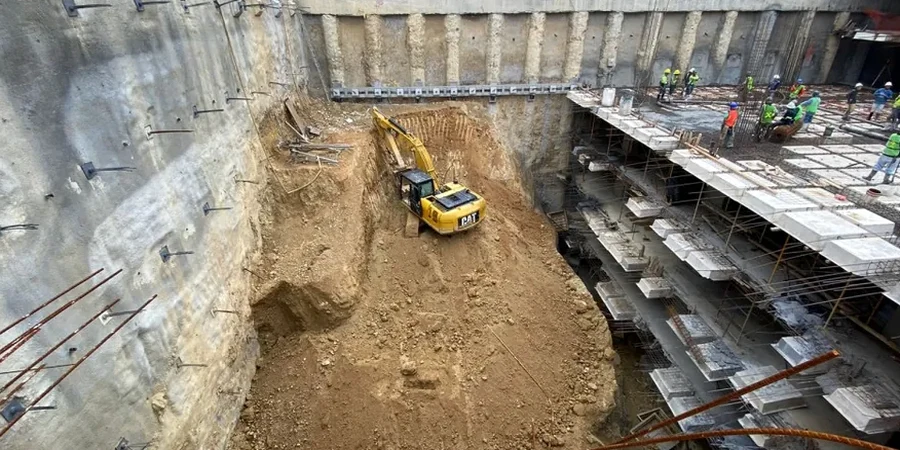
A recent project on a former agricultural parcel south of Downtown Fresno illustrates the challenges we routinely solve. The site investigation revealed a 12-foot-thick layer of fat clay overlying a dense sand unit that was artesian during wet winters. We designed a soldier pile and lagging system with post-tensioned tiebacks, using beam-on-elastic-foundation analysis to account for the stiffness degradation of the clay under repeated seasonal moisture cycles. The excavation reached 28 feet, and we incorporated a jet-grout bottom seal to control basal heave, a solution that emerged from finite element modeling calibrated with triaxial testing results from undisturbed Shelby tube samples. Our approach in the Central Valley emphasizes staged excavation sequencing because the stress history of these normally consolidated to lightly overconsolidated soils means that unloading response is highly time-dependent, and we have documented cases where apparent earth pressures increased by 15 percent over a six-week open-cut period simply due to pore pressure equilibration.
Geotechnical Design of Deep Excavations in Fresno’s Central Valley
Technical reference — Fresno

Local considerations

Fresno’s urban core expanded rapidly after the completion of the Central Valley Project canals in the 1940s, and many mid-rise buildings constructed during that era sit on shallow foundations that are vulnerable to excavation-induced settlement. We have investigated multiple claims where adjacent structures experienced angular distortion exceeding 1/300 simply because the dewatering radius of influence extended beneath older brick-clad buildings with lime-mortar foundations. In the current regulatory environment, the City of Fresno requires a pre-construction condition survey and vibration monitoring plan for any excavation deeper than 12 feet within 50 feet of a property line. Our risk assessments incorporate the Cording and O’Rourke damage criteria to define tolerable ground loss, and we specify compensation grouting trigger levels before shoring installation begins. The combination of liquefiable sand lenses and a design earthquake of moment magnitude 7.0 or greater on the San Andreas means that post-seismic lateral spreading must be evaluated even for temporary excavation support systems.

Need a geotechnical assessment?

Reply within 24h.

Email: contact@geotechnicalengineering1.com

Video overview

Relevant standards

ASCE 7-22: Minimum Design Loads and Associated Criteria for Buildings and Other Structures, IBC 2024 (California Building Code, Title 24, Part 2), Caltrans Trenching and Shoring Manual (current edition), ASTM D1586-18: Standard Test Method for Standard Penetration Test (SPT) and Split-Barrel Sampling of Soils, ASTM D2487-17: Standard Practice for Classification of Soils for Engineering Purposes, FHWA-NHI-10-024: Earth Retaining Structures and Slope Stability

Technical parameters

ParameterTypical value
Maximum excavation depth designed40 ft (typical), deeper with peer review
Design frameworkASCE 7-22, IBC 2024, Caltrans Trenching & Shoring Manual
Lateral earth pressure methodApparent pressure diagrams (Terzaghi-Peck modified for soft-to-medium clays)
Seismic coefficient (kh)0.15–0.25g depending on site class and proximity to San Andreas Fault
Groundwater controlDeep wells, eductors, or jet-grout bottom seal depending on aquifer connectivity
Soil constitutive modelHardening Soil with small-strain stiffness (HS-small) for FEM in PLAXIS
Base stability analysisTerzaghi bearing, basal heave (Bjerrum and Eide), and 3D FEM for irregular footprints

Frequently asked questions

What is the typical cost range for a deep excavation design in Fresno?
How does Fresno's alluvial geology affect deep excavation design compared to coastal California cities?

Fresno sits on thick, interbedded deposits of the San Joaquin Valley where soils are generally younger and less overconsolidated than the stiff marine clays found in San Francisco or Los Angeles. This means that base stability and time-dependent deformation are often the controlling design factors here, rather than the high lateral earth pressures typical of heavily overconsolidated formations.

What seismic parameters do you use for deep excavation design in Fresno?

We determine the seismic coefficient from the MCE ground motion maps in ASCE 7-22, adjusted for site class effects specific to the Central Valley basin. For most sites in Fresno, the design peak ground acceleration ranges from 0.15g to 0.25g, and we apply the Mononobe-Okabe method or calibrated numerical models to calculate seismic earth pressure increments on the shoring system.

Do you handle the dewatering permit process with local agencies?

Yes, we prepare the technical documentation required for discharge permits from the Central Valley Regional Water Quality Control Board. This includes the hydrogeologic characterization of the site, predicted flow rates, and proposed treatment methods if the extracted groundwater contains constituents above the applicable water quality objectives.

What instrumentation do you typically specify for a deep excavation in Fresno's urban areas?

For projects adjacent to occupied structures, we specify inclinometers behind the shoring to track lateral deflection with depth, vibrating-wire piezometers to monitor pore pressure dissipation, optical survey prisms on adjacent building facades, and seismographs to measure construction vibration. Trigger levels are set based on the Cording and O'Rourke damage criteria for the specific building typology.

Location and service area

We serve projects across Fresno and surrounding areas. More info.

View larger map