GEOTECHNICALENGINEERING1
FRESNO
HomeSeismicBase isolation seismic design

Base Isolation Seismic Design in Fresno: Protecting Structures from Valley Faults

Sound ground. Sound decisions.

LEARN MORE

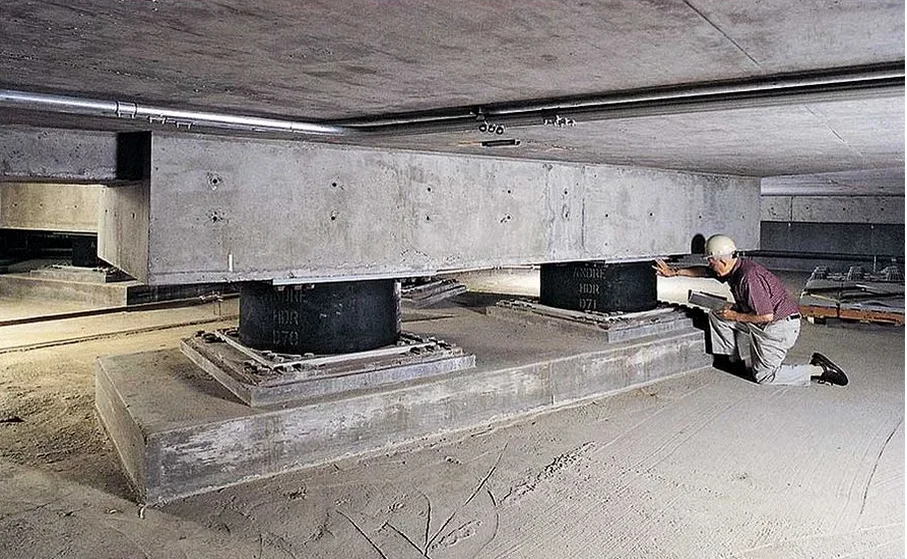
Fresno sits just 30 miles from the San Andreas Fault. The 2019 Ridgecrest sequence rattled windows here—a reminder that distance doesn’t equal safety. Soft basin soils amplify shaking in ways rigid code minimums miss. Base isolation seismic design changes the equation entirely. Instead of bracing for impact, we decouple the structure from the ground. Our lab team runs site-specific ground motion analysis using ASCE 7-22 Chapter 17 procedures. We combine deep soil borings with CPT testing to map shear wave velocity profiles. That data feeds directly into isolator selection—lead rubber bearings, friction pendulum systems, or high-damping rubber. For critical facilities in downtown Fresno, the approach cuts spectral acceleration demands by 60% or more.

Decoupling a building from the ground isn't just engineering—it's changing the physics of how seismic energy enters the structure.
Our service areas

Process and scope

The San Joaquin Valley basin traps seismic energy. Soft alluvial deposits over 2,000 feet deep create a resonance chamber. Long-period waves travel far and hit hard here. Base isolation works with this geology, not against it. We design the isolation plane to shift the structure’s period above 2.5 seconds—well past the soil’s dominant frequency. Our process starts with MASW surveys to confirm Vs30 values and site class. Then nonlinear time-history analysis runs seven ground motion pairs scaled to the Fresno-Clovis Metropolitan Area seismic hazard. The isolator displacement capacity is checked against MCE-level shaking. We verify stability under maximum considered earthquake plus 30% per ASCE 7 redundancy requirements. Every bearing gets prototype testing records reviewed before specification. Moats and utility connections receive equal design attention—no weak links left behind.
Base Isolation Seismic Design in Fresno: Protecting Structures from Valley Faults
Technical reference — Fresno

Local considerations

We bring a triaxial shake table controller to site-specific verification. The rig validates isolator prototypes under load histories we derive from Fresno basin ground motions. Not generic waveforms—actual records modified for local soil amplification. A bad isolation design is worse than no isolation. If the moat jams or utilities snap, you’ve concentrated failure at the isolation plane. We’ve seen projects where an undersized lead core yielded thermal movement—not earthquake—and locked the system. Our team reviews every submittal against ASCE 7-22 Section 17.8 compliance. Prototype testing, production testing, and installation tolerances all get checked. We coordinate with the structural engineer to ensure the superstructure remains elastic above the isolation plane. The goal: immediate occupancy after the design earthquake. No damage. No downtime.

Need a geotechnical assessment?

Reply within 24h.

Email: contact@geotechnicalengineering1.com

Relevant standards

ASCE/SEI 7-22 Chapter 17: Seismic Isolation, IBC 2024 Section 1705.16: Special Inspections for Isolated Structures, ASCE/SEI 41-23: Seismic Evaluation and Retrofit (isolation retrofit provisions), AASHTO Guide Specifications for Seismic Isolation Design (bridge applications)

Technical parameters

ParameterTypical value
Target structural period (isolated)2.5–4.0 seconds
Design spectral acceleration (SDS, Site Class D)0.8g–1.2g per USGS NSHM
Isolator displacement capacity (DMCE)18–32 inches typical
Equivalent viscous damping15–30% (LRB / HDR / FPS)
Minimum moat clearanceDMCE + 10% per IBC
Upper-bound / lower-bound analysis±20% property variation
Wind restraint thresholdFPS slip load > 25-year wind

Frequently asked questions

How much does base isolation seismic design cost for a Fresno project?
When is base isolation required instead of conventional seismic design in Fresno?

Base isolation becomes the preferred solution for Risk Category IV facilities (hospitals, emergency response centers, fire stations) and for buildings where immediate occupancy after a major earthquake is non-negotiable. It’s also specified for structures with sensitive contents—data centers, museums, laboratories—where conventional design can’t economically limit floor accelerations below 0.3g.

What soil conditions in the San Joaquin Valley affect isolator performance?

Deep alluvial deposits amplify long-period ground motion. Site Class D and E predominate in Fresno. Soft soils push the response spectrum peak toward longer periods. We run site-specific response analysis to capture basin edge effects and impedance contrasts. This soil profile actually favors isolation because the shifted structural period avoids soil resonance.

How long does the base isolation design process take?

A full base isolation design package—from ground motion development through peer review completion—typically runs 10 to 14 weeks. The critical path is the nonlinear time-history analysis and the iterative isolator property refinement. Prototype testing at the manufacturer adds 6 to 8 weeks to the procurement schedule, which we coordinate in parallel with design.

Location and service area

We serve projects across Fresno and surrounding areas.

View larger map