GEOTECHNICALENGINEERING1
FRESNO
HomeSlopes & WallsRetaining wall design

Retaining Wall Design in Fresno: Engineering for the Valley's Expansive Soils

Sound ground. Sound decisions.

LEARN MORE

IBC Chapter 18 and ASCE 7 set the baseline for retaining structures, but in Fresno the real design challenge starts below grade. The city sits on Pleistocene alluvial fans of the San Joaquin Valley, where expansive clay layers alternate with silty lenses. These soils swell when wet and shrink when dry, imposing lateral pressures that generic designs simply cannot handle. A retaining wall design here means reading the soil before sizing the stem. Our technical team runs laboratory swell tests and direct shear on undisturbed samples to define the active wedge, then models the structure for sliding and overturning under saturated conditions. For sites near the Fresno-Clovis boundary where granular lenses appear, we often combine the retaining wall analysis with a footing investigation to verify bearing capacity at the base of the wall, or with slope stability analysis when the wall is part of a larger cut-fill sequence.

A retaining wall in Fresno is only as good as the soil data behind it. Swell pressure and drainage control make or break the design.
Our service areas

Process and scope

Fresno's urban grid expanded rapidly after the Central Valley Project brought irrigation canals in the mid-20th century. That growth pushed development into areas underlain by San Joaquin Formation clays, which geotechnical engineers across the region know for their high plasticity. The retaining wall design we deliver incorporates site-specific Atterberg limits and consolidation data, because a wall founded on CH clay behaves differently than one on well-graded sand. Key characteristics include:
  • Backfill drainage specification matched to the low-permeability native soil, preventing hydrostatic buildup behind the stem.
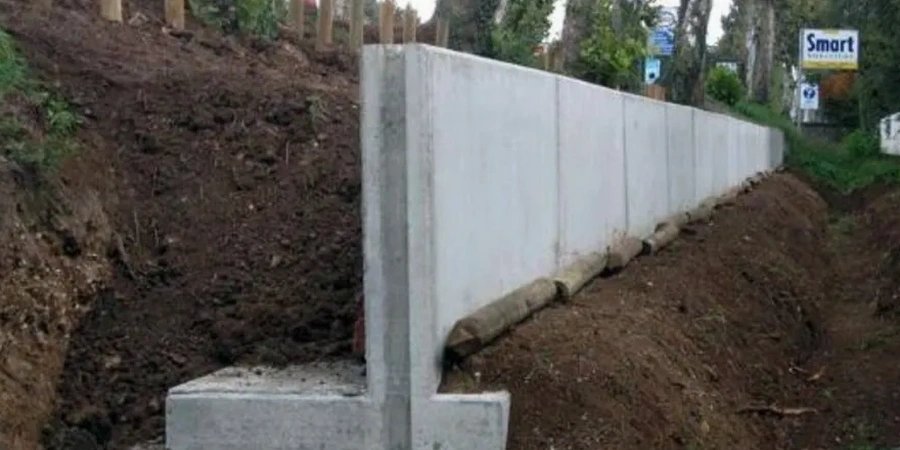
  • Reinforcement detailing for cantilever and gravity walls, designed per ACI 318 and IBC load combinations.
  • Global stability checks using Spencer's method when the wall is placed mid-slope or above a descending grade.
  • Expansive soil mitigation through deepened base embedment and select fill replacement in the active zone.
Retaining Wall Design in Fresno: Engineering for the Valley's Expansive Soils
Technical reference — Fresno

Local considerations

The semi-arid Central Valley climate creates a feast-or-famine moisture cycle that punishes retaining walls. Fresno averages just over 11 inches of rain annually, but when winter atmospheric rivers arrive, the clay swells rapidly and lateral earth pressures spike well above the drained design envelope. Conversely, prolonged summer drought shrinks the soil and can open a gap between the backfill and the stem, inviting surficial erosion during the first heavy rain. Seismic demand adds another layer: Fresno lies within shaking Zone 3 per the USGS hazard maps, and a retaining wall design must account for the additional dynamic earth pressure increment required by ASCE 7-22 Section 11.8. We model the wall for the 2,475-year return period event, verifying that the reinforced stem and footing can resist the combined static plus seismic thrust without excessive rotation.

Need a geotechnical assessment?

Reply within 24h.

Email: contact@geotechnicalengineering1.com

Relevant standards

ASCE 7-22 (Minimum Design Loads for Buildings and Other Structures), IBC 2021 Chapter 18 (Soils and Foundations), ACI 318-19 (Building Code Requirements for Structural Concrete), ASTM D4318 (Atterberg Limits), ASTM D4546 (One-Dimensional Swell of Cohesive Soils)

Technical parameters

ParameterTypical value
Design standardIBC 2021, ASCE 7-22
Soil unit weight range110–130 pcf (native clays)
Typical wall height4 to 18 ft
Backfill typeOpen-graded gravel with filter fabric
Drainage elementPerforated toe drain, 4-in diameter
Sliding resistance factorFS ≥ 1.5 (static), 1.1 (seismic)
Expansive potentialModerate to high (PI 20–45)

Frequently asked questions

How much does a retaining wall design cost for a Fresno project?
What soil parameters are critical for retaining wall design in the San Joaquin Valley?

Swell pressure, drained friction angle, and cohesion are the big three. In Fresno's expansive clays, we also need the plasticity index and the depth of the active moisture zone. Those numbers drive the backfill specification and the embedment depth.

Do retaining walls here require a building permit?

Yes. The City of Fresno requires a permit for any retaining wall over 4 feet in height measured from the bottom of the footing, or for any wall supporting a surcharge. The submittal must include stamped structural calculations and a soils report.

What type of backfill works best behind a retaining wall in Fresno?

Open-graded gravel wrapped in filter fabric is the standard recommendation. The native clay has very low permeability, so we need a positive drainage path to prevent water from ponding in the backfill zone and doubling the lateral pressure.

Location and service area

We serve projects across Fresno and surrounding areas.

View larger map