GEOTECHNICALENGINEERING1
FRESNO
HomeIn-Situ TestingField density test (sand cone method)

Field Density Testing with Sand Cone Method in Fresno, CA

Sound ground. Sound decisions.

LEARN MORE

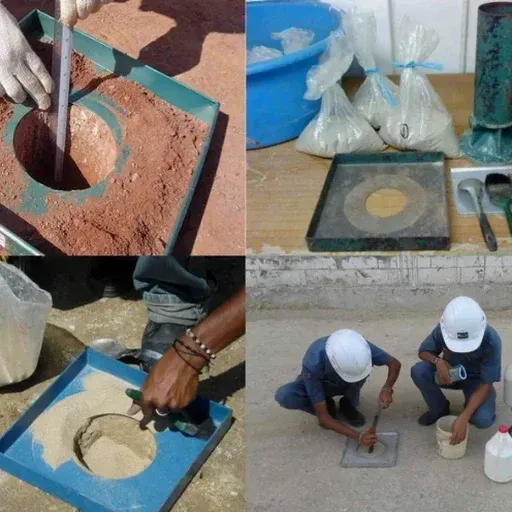
The hardpan soils of Fresno County demand a compaction testing partner who understands the Central Valley's unique subsurface profile. With summer temperatures exceeding 100°F and the San Joaquin Formation's dense, cemented layers, verifying in-place density here is not a routine checkbox exercise. The sand cone method, governed by ASTM D1556, remains the most reliable field verification for granular soils where nuclear gauges give erratic readings due to the region's high iron content and dry crust. Because Fresno sits atop a massive alluvial fan complex extending from the Sierra Nevada foothills, bearing capacity and settlement potential hinge entirely on achieving the specified relative compaction. Our team has run thousands of these tests on projects ranging from Highway 99 widening to warehouse tilt-ups in the industrial corridor. Before placing the sand cone, we often correlate results with laboratory Proctor tests to establish the target maximum dry density for each specific borrow source used on site.

In Fresno's hardpan, a 2 percent drop in relative compaction can reduce the allowable bearing pressure by over 300 psf. The sand cone method catches that delta before the slab does.
Our service areas

Process and scope

On a recent 14-acre distribution center off Jensen Avenue, the earthwork contractor encountered alternating lenses of sandy silt and stiff clay at subgrade. Achieving 95 percent relative compaction under the future slab required more than a single pass with a sheepsfoot roller. The sand cone test, run at 50-foot grid spacing per the project's geotechnical specifications, revealed density variations of over 8 pcf between adjacent lifts. This is typical of Fresno's basin deposits, where subtle changes in gradation from the Kings River outwash affect moisture-density relationships. Our procedure follows the California Test 216 method for the sand volume correction factor, accounting for the subtle vibration-induced settlement of the Ottawa sand during calibration. For sites where deeper lift verification is needed, the SPT drilling program can be correlated with the near-surface compaction data to build a complete profile of the fill and native material. The sand cone excels in trench backfill scenarios where the narrow geometry restricts other methods, especially along the city's expanding sewer trunk lines south of Highway 180.
Field Density Testing with Sand Cone Method in Fresno, CA
Technical reference — Fresno

Local considerations

The older residential neighborhoods near Tower District sit on undisturbed San Joaquin Formation hardpan that naturally exceeds 100 pcf in dry density. In contrast, the newer subdivisions sprawling toward Clovis often rise on engineered fill placed over former agricultural parcels where deep ripping disturbed the native structure. Skipping sand cone verification in these transition zones means accepting compaction assumptions that can fail under the differential settlement loading common to the Fresno-Clovis metropolitan area. A footing spanning cut-fill boundaries without verified density data develops hairline fractures within the first irrigation season. The sand cone method provides a direct measurement of the fill's unit weight, independent of the electronic drift or calibration errors that plague nuclear density gauges in this soil matrix. For sites adjacent to the Friant-Kern Canal, where seepage elevates moisture content seasonally, the grain size analysis of the fill material determines whether the achieved density will persist under fluctuating saturation conditions.

Need a geotechnical assessment?

Reply within 24h.

Email: contact@geotechnicalengineering1.com

Video overview

Relevant standards

ASTM D1556: Standard Test Method for Density and Unit Weight of Soil in Place by Sand-Cone Method, AASHTO T-191: Density of Soil In-Place by the Sand-Cone Method, ASTM D698: Standard Test Methods for Laboratory Compaction Characteristics of Soil Using Standard Effort

Technical parameters

ParameterTypical value
Test standardASTM D1556 / AASHTO T-191
Applicable soil typesGranular soils with max particle size <1.5 in
Test depth range4 to 8 inches (single lift)
Test duration per point15 to 20 minutes
Density unit outputpcf (lb/ft³) or kg/m³
Minimum test hole volume3x max particle size
Sand calibrationOttawa 20-30 sand, bulk density check daily

Frequently asked questions

How much does a field density test using the sand cone method cost in Fresno?
Why use the sand cone method instead of a nuclear density gauge on Fresno hardpan?

The San Joaquin Formation hardpan contains naturally high concentrations of iron oxides and dense cementation that scatter neutrons unpredictably, producing erroneous readings with nuclear gauges. The sand cone method measures density directly by excavating a known volume of soil and weighing it — no radiation source, no calibration drift, and no interference from soil chemistry. It is the preferred method for compaction verification on Fresno County public works projects for this reason.

What is the minimum number of sand cone tests required per lift?

The City of Fresno Public Works standard and IBC Chapter 18 typically require one test per 2,500 square feet of compacted lift area, with a minimum of three tests per lift regardless of area. For utility trench backfill, the spacing tightens to one test every 50 linear feet per lift. The responsible geotechnical engineer may adjust these frequencies based on the criticality of the structure and the variability of the fill material.

How deep can the sand cone test measure compaction?

The standard sand cone test measures density within a single compacted lift, typically 6 to 8 inches in thickness. The test hole is excavated to the full depth of the lift but not beyond, because the method measures the average density of the removed material. For thicker fills, multiple tests are performed on each successive lift. If verification of deeper fill layers is required after placement, methods like the SPT or CPT are substituted.

Can the sand cone method be used in trench backfill with utility conflicts?

Yes, the sand cone method is particularly well-suited to trench backfill testing in Fresno's congested utility corridors. The 6-inch cone and small excavation diameter allow testing between conduit runs and around manhole structures where a nuclear gauge's footprint would not fit. The technician must avoid disturbing exposed utilities during the excavation, and the test hole location is documented on the as-built density map for the trench.

Location and service area

We serve projects across Fresno and surrounding areas.

View larger map