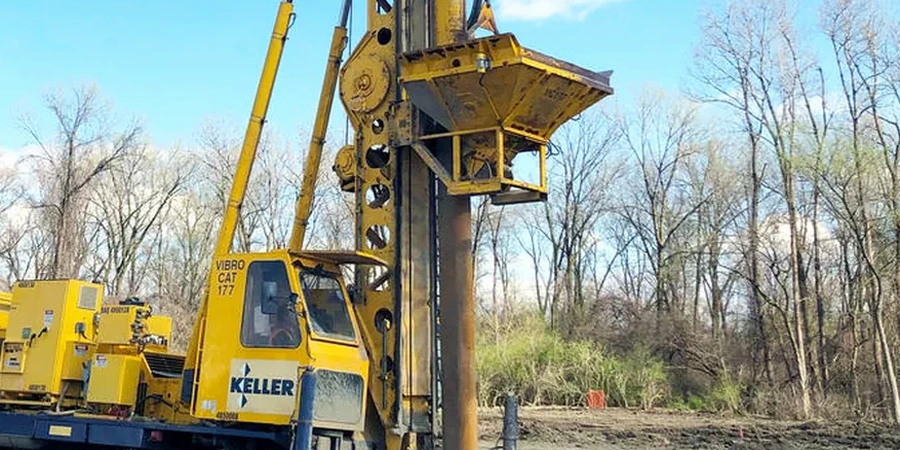
A five-story medical office building proposed near Herndon Avenue hit a snag during preliminary geotech review. The site sits on loose alluvial sands deposited by the San Joaquin River system, with SPT N-values below 8 in the upper 25 feet. Groundwater at 12 feet depth raised immediate liquefaction concerns under ASCE 7-16 seismic criteria. Standard over-excavation would have required massive dewatering and off-haul. The project team shifted to a vibrocompaction design approach, targeting a 70% relative density threshold to eliminate liquefaction susceptibility. Fresno's hot, dry summers actually aid the process; low moisture content in the near-surface sands allows efficient densification before hitting the water table. The liquefaction analysis confirmed a factor of safety below 0.8 for the design earthquake, making ground improvement mandatory, not optional. Our design specified a triangular grid at 7-foot spacing using an electric vibrator with 130 kW power to achieve the required depth of improvement down to 32 feet, well below the critical layer.
Achieving a post-treatment relative density above 70% in Fresno's alluvial sands transforms a liquefiable profile into a competent bearing stratum for shallow foundations.