GEOTECHNICALENGINEERING1
FRESNO
HomeSlopes & WallsActive/passive anchor design

Active and Passive Anchor Design for Central Valley Soil Conditions

Sound ground. Sound decisions.

LEARN MORE

Fresno's growth since the 1880s rail expansion pushed construction across the Kings River alluvial fan, where loose sands and variable clay lenses challenge deep excavation support. The 2019 Highway 99 widening project exposed just how quickly anchor capacity can shift within a single city block if the soil profile is misread. Our lab team works directly with contractors who need tieback anchors that hold under both static earth pressure and the seismic loads ASCE 7 demands for this region. We run grout cube tests, tendon inspection, and pull-out verification so that design assumptions match what the ground actually delivers. For sites near the San Joaquin River where groundwater sits shallow, in-situ permeability testing gives the pore pressure data that anchor bond length calculations depend on.

A properly tested anchor in Fresno alluvium can cut wall deflection by 40% compared to an unverified design, simply by matching grout mix to the actual silt content.
Our service areas

Methodology and scope

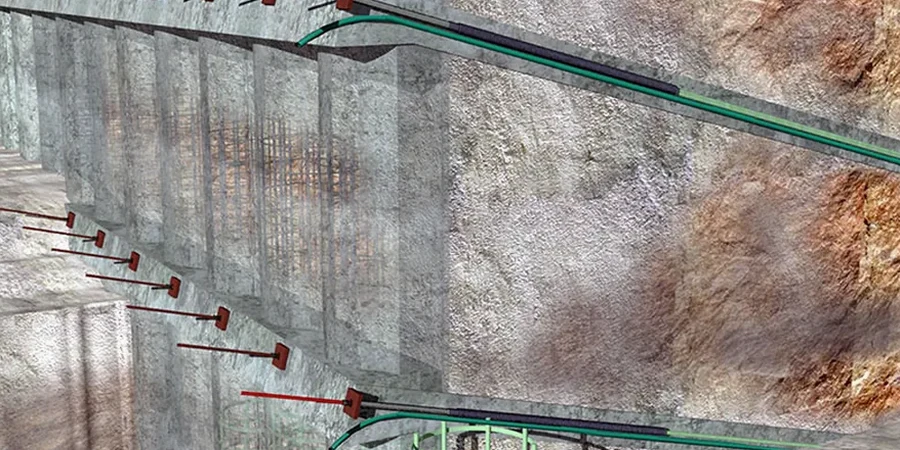
Fresno sits on deep Quaternary alluvium with sands, silts, and stiff clays that can vary from SM to CL within a 20-foot borehole. This stratigraphy directly affects anchor type selection: passive anchors rely on soil-grout friction in the bond zone, while active anchors are stressed against a structural face to control wall deflection. Our lab verifies both designs by testing grout compressive strength at 7 and 28 days per ASTM C109, and we measure tendon elongation under load following PTI DC35.1 recommendations. When the bond zone extends into sandy layers below 40 feet, CPT testing helps confirm the friction ratio and sleeve resistance before installation begins. For retaining wall anchors in areas like the Fig Garden neighborhood where older clay layers dominate, slope stability analysis often runs parallel to anchor design to ensure global stability isn't compromised.
Active and Passive Anchor Design for Central Valley Soil Conditions
Technical reference — Fresno

Local considerations

A standard hollow-stem auger rig with hydraulic jacks and a load cell setup is what our team uses for anchor pull-out testing across Fresno sites. The real risk isn't the equipment itself, it's skipping bond zone verification in soils with high silt content. Silty sands reduce grout-to-ground bond strength by up to 30% compared to clean sands, and if that loss isn't caught during proof testing, the anchor creeps under sustained load. We've pulled test anchors near Highway 41 where the residual movement exceeded 0.04 inches within the first 10 minutes, a clear signal that the bond length needed adjustment. On one industrial project in southeast Fresno, switching from a straight-shaft to a post-grouted anchor increased ultimate capacity by 60% after the initial test showed inadequate bond in silty fine sand.

Need a geotechnical assessment?

Reply within 24h.

Email: contact@geotechnicalengineering1.com

Applicable standards

PTI DC35.1-14 (Post-Tensioning Institute – Recommendations for Prestressed Rock and Soil Anchors), FHWA-RD-97-130 (Geotechnical Engineering Circular No. 4 – Ground Anchors and Anchored Systems), ASTM A416 / A722 (Tendon strand and bar specifications), ASCE 7-22 Section 2.3 (Load combinations including seismic for Site Class D), IBC 2021 Chapter 18 (Soils and Foundations, referencing anchor testing requirements)

Technical parameters

ParameterTypical value
Grout compressive strength (28-day)3,000–5,000 psi per ASTM C109
Tendon grade for active anchorsGrade 270 (ASTM A416) or Grade 150 (ASTM A722)
Bond length in sandy alluvium15–25 ft typical, verified by pull-out test
Unbonded length (active anchors)Extends beyond failure plane per FHWA-RD-97
Proof test load133% of design load, held 10 minutes
Performance test criterionCreep ≤ 0.04 in. over 6–60 minute period
Corrosion protection classClass I (PTI) for permanent anchors in aggressive soils

Frequently asked questions

What's the difference between active and passive anchors?

Active anchors are tensioned against a structural face after grout curing, applying immediate load to control wall movement. Passive anchors are not tensioned; they resist load only when the retained soil begins to move and engage the anchor. In Fresno's alluvial soils, active anchors are preferred for deep excavations near existing buildings because they limit deflection from the start.

How much does anchor design and testing cost for a typical project?

For a project requiring anchor design verification and load testing, costs typically range from US$1,060 to US$4,310 depending on the number of anchors tested, the depth of the bond zone, and whether performance or proof testing is required. A single sacrificial test anchor with full instrumentation runs at the higher end of that range.

Does Fresno's seismic classification affect anchor design?

Yes. Fresno falls under ASCE 7 Site Class D in most areas, which increases the seismic lateral earth pressure that anchored walls must resist. Anchor design must account for these additional loads in the load combination, and PTI guidelines require that anchors maintain capacity under cyclic loading conditions representative of the design earthquake.

Location and service area

We serve projects across Fresno and surrounding areas.

View larger map