GEOTECHNICALENGINEERING1
FRESNO
HomeGround improvementStone column design

Stone Column Design in Fresno: Ground Improvement for Soft Alluvial Soils

Sound ground. Sound decisions.

LEARN MORE

Driving a casing through Fresno's subsurface often reveals what the San Joaquin Valley is known for: deep sequences of interbedded silts, clays, and loose sands deposited over millennia by the Kings and San Joaquin River systems. When the standard penetration test from an SPT drilling program comes back with N-values consistently under eight in the upper twenty feet, traditional spread footings become impractical. Stone column design offers a ground improvement alternative that densifies the surrounding soil and creates stiff, load-bearing elements through the soft zone. The design process for Fresno County requires careful consideration of the basin's variable groundwater, typically encountered between ten and twenty feet below grade, and the potential for liquefaction in the loose granular layers that are common across the 36.7° latitude line. Our approach integrates seismic settlement analysis from the start, recognizing that a stone column array must perform during a design event as well as under static building loads.

A properly designed stone column grid can reduce settlement by fifty to seventy percent compared to untreated ground, transforming a marginal site into buildable land.
Our service areas

Methodology and scope

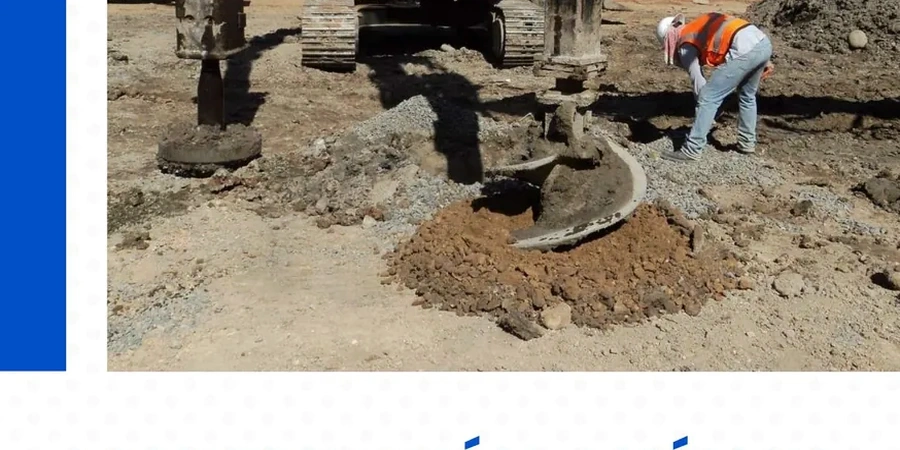
The design methodology referenced for stone column projects in this region follows the FHWA Ground Improvement Manual (FHWA-NHI-16-027) and the Priebe method for estimating settlement reduction. In Fresno, where the soil profile often alternates between stiff desiccated crust and soft saturated clay, the unit cell concept is applied to predict how the composite ground will behave under load. A critical parameter is the area replacement ratio, typically ranging from ten to thirty-five percent depending on the target bearing capacity and allowable total settlement, which for most commercial structures here is capped at one inch. The column diameter, usually between two and a half and four feet, is selected based on the vibratory probe or bottom-feed equipment available and the depth of the compressible layer, which in east Fresno can extend beyond forty feet. Drainage capacity is another factor that distinguishes stone columns from rigid inclusions: the columns act as vertical drains, accelerating consolidation in the surrounding clay and allowing much of the post-construction settlement to occur before the slab is poured. This dual function is particularly effective in the low-permeability clays of the Tulare Formation that underlie much of the metropolitan area.
Stone Column Design in Fresno: Ground Improvement for Soft Alluvial Soils
Technical reference — Fresno

Local considerations

A frequent misstep on Fresno projects is specifying stone columns based solely on a static settlement analysis without running a deformation analysis under seismic loading. The 2014 NAPA earthquake and the region's proximity to the San Andreas Fault system mean that loose sand layers between ten and thirty feet can trigger liquefaction, which causes a sudden loss of confinement and column bulging. Another field error occurs when the contractor attempts to advance the vibrator through a stiff clay crust without pre-drilling, leading to excessive amperage, refusal above the design depth, and a column that terminates in the bearing layer instead of penetrating through it. This creates a soft toe condition that compromises the entire grid. A third issue arises from loading the columns before the excess pore pressures generated during installation have dissipated; in the low-permeability clays of the Fresno basin, this can take two to four weeks and must be factored into the construction schedule. The design must specify a waiting period and, ideally, a verification program using CPT soundings or full-scale modulus tests.

Need a geotechnical assessment?

Reply within 24h.

Email: contact@geotechnicalengineering1.com

Applicable standards

FHWA-NHI-16-027 Ground Improvement Manual, ASCE 7-22 Chapter 19 (Seismic Ground Motion), ASTM D1586-18 Standard Penetration Test, IBC 2024 Section 1806 (Foundation Design)

Technical parameters

ParameterTypical value
Applicable design methodPriebe (1995) / FHWA-NHI-16-027
Typical column diameter2.5 to 4.0 ft
Area replacement ratio range10% to 35%
Target allowable settlement (commercial)≤ 1.0 inch total
Depth range in Fresno basin15 to 50 ft below grade
Typical column spacing5 to 10 ft on center (triangular grid)
Groundwater considerationGW at 10-20 ft; design for submerged unit weight
Seismic checkLiquefaction triggering per Boulanger & Idriss (2014)

Frequently asked questions

What is the typical cost range for stone column design in Fresno?

For a site in the Fresno area requiring ground improvement, the design engineering scope including feasibility analysis, settlement calculations, and construction-ready drawings generally ranges from US$1,550 to US$5,940. The final cost depends on the footprint of the treatment area, the number of borings and CPT soundings to be analyzed, and whether a 3D finite element model is required for the project's loading complexity.

How does stone column design account for liquefaction in Fresno?

The design process incorporates a liquefaction triggering analysis using SPT or CPT data per the Boulanger and Idriss (2014) procedure. If liquefiable layers are identified within the treatment depth, the stone column grid is designed to provide both densification and drainage. The column spacing is tightened to increase the area replacement ratio, and the aggregate gradation is specified to maintain permeability under seismic loading. Post-treatment verification with CPT confirms that the target improvement has been achieved before the structural design proceeds.

What soil conditions in Fresno are suitable for stone columns?

Stone columns perform well in the soft to medium-stiff clays and loose sands that characterize much of the Fresno basin. They are most effective when the undrained shear strength of the cohesive layers is between 15 and 50 kPa. Soils with undrained shear strength below 15 kPa may not provide adequate lateral confinement and require a careful evaluation or a switch to rigid inclusions. The interbedded nature of the Tulare Formation deposits here means that a layer-by-layer assessment from a detailed boring log is essential to determine suitability across the full treatment depth.

How long does the stone column design and installation process take in Fresno?

The design phase, from receiving the final geotechnical report to issuing stamped construction drawings, typically takes three to four weeks. Field installation for a typical commercial building footprint can be completed in one to two weeks with a single rig. The critical path item in Fresno is the post-installation waiting period for pore pressure dissipation, which ranges from two to four weeks depending on the clay content. Foundation construction should not begin until the verification CPT results confirm the design improvement has been achieved.

Location and service area

We serve projects across Fresno and surrounding areas.

View larger map